Recent headlines tout “teleportation across thousands of kilometers.” Here’s what was really done, why it matters for a future quantum internet, and what it doesn’t mean.
First: teleportation ≠ moving objects
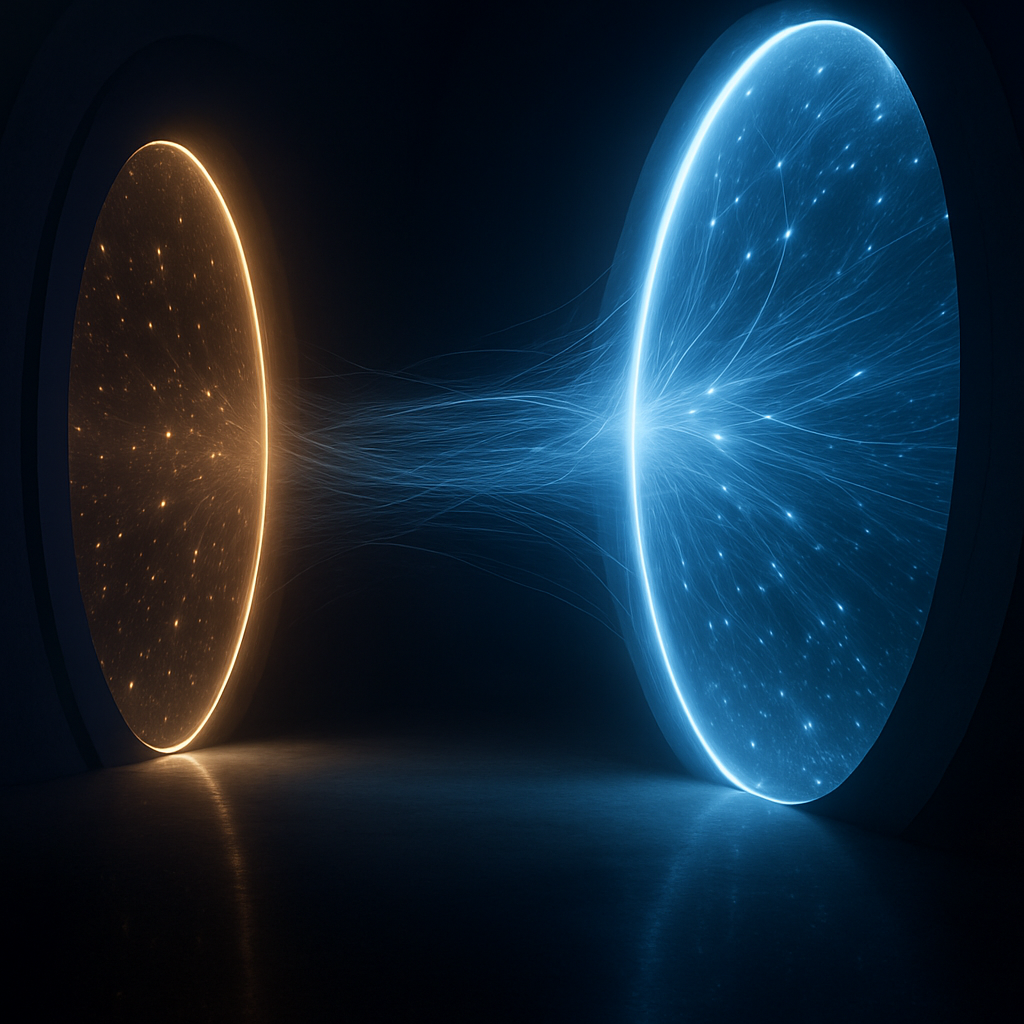
Quantum teleportation transfers a quantum state (information) from one particle to another at a distance. It still requires a classical channel, so it doesn’t send messages faster than light or beam matter anywhere.
Think “cloning the state elsewhere,” not “moving the thing itself.”
What’s been demonstrated so far
2017: Ground-to-satellite teleportation of single-photon qubits to the Micius satellite over ~1,400 km.
2017: Satellite-based distribution of entangled photons between two ground stations ~1,200 km apart.
2021: An integrated quantum network spanning ~4,600 km using fiber and satellite QKD links.
These steps are building the backbone for long-range, quantum-secure networking.
Why it matters
Security: Quantum key distribution can reveal eavesdropping attempts.
Reach: Space links avoid fiber losses, enabling continent-scale connections.
Roadmap: With more satellites and ground stations, a global quantum network becomes feasible.
What it doesn’t do (yet)
No faster-than-light communication.
No teleportation of people or devices.
Scaling is hard: sources, detectors, pointing, and loss all bite.

 Quantum Quill Media (Official Site)
 Astrabionics (Official Site)
 Awards

 English
 Arabic
 Spanish
 Portuguese
 Deutsch
 Turkish
 Dutch
Dutch
 Italiano
 Russian
 Romaian
 Portuguese (Brazil)
 Greek
Greek