
 Quantum Quill Media (Official Site)
 Astrabionics (Official Site)
 Awards
Bottleneck Rechner The Secret Tool Every Gamer and PC Builder Needs
For those who have invested hours configuring a graphics card, processor, and RAM then been let down with poor performance and slow frame rates, bottlenecking is likely the reason. This is the situation a Bottleneck Rechner hopes to address. Beyond the technology, it acts as a companion, helping you determine if the components within your PC are aligned and working together as one cohesive unit, or were mismatched and set to compete with one another.
What Is a Bottleneck, and Why Should You Care?
Beyond a technical description, a bottleneck can be understood with a simple analogy. All the cars on a highway need to pass through a narrow bridge. No matter how fast the cars are moving, they will have to slow. That bridge is the bottleneck. Similarly, in a computer, a component that is slower than the rest creates a bottleneck, restricting overall performance.
Consider the following scenarios:
The latest RTX 4090 and an old Intel i5 CPU are paired together.
Fast DDR5 RAM is on a motherboard that only supports DDR3.
High-end CPU is paired with an entry-level graphics card.
The result is the same in all scenarios, lag and frustration.
Enter Digital Performance Advisor: Bottleneck Rechner
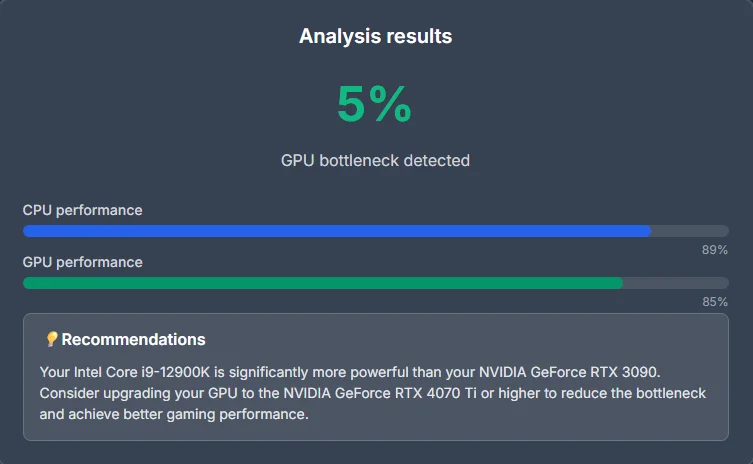
Bottleneck Rechner is an online tool that checks whether your CPU and GPU are working together or if one is slowing the other down. You simply provide the system components—processor, graphics card, RAM, and sometimes resolution—and the tool checks the combination.
The tool provides a numerical value that expresses the bottleneck percentage. For example:
5% bottleneck—Perfect balance; you can expect smooth performance.
10-15% bottleneck—Slight imbalance but acceptable for gaming.
20% or more—One component is significantly holding your system back.
Bottleneck Rechner Is For Gamers
Gamers and PC enthusiasts around the world rely on Bottleneck Rechner for several reasons:
Saves Money
The tool allows you to identify the component that needs upgrading. It can save you from buying a new GPU if your CPU bottleneck.
Smart Upgrades
Planning to purchase a new graphics card or processor? A bottleneck calculator can help you determine if your system can handle the new component.
Enhanced Performance
With compatible components installed, you will experience better FPS, reduced rendering time, smoother gameplay, and overall optimal performance.
How to Use a Bottleneck Rechner – Step-by-Step
Not to worry, using the tool is simple, even for those lacking technical skills. Here’s the process:
Access a Bottleneck Rechner webpage.
From the drop-down menu, pick your CPU.
Select your GPU.
Type in your RAM and, in some cases, your storage (SSD/HDD) for the calculator.
Hit ‘Calculate’ or ‘Analyze’.
Well within a time-frame of a few seconds, you will see system results and whether your system is balanced or if there is a bottleneck.
Is the Bottleneck Rechner Tool Always Correct?
The simple answer is no. Although a Bottleneck Rechner is handy, it is not perfect. It provides general estimations based on all the data it contains and not on your specific system. Performance will always be affected by background processes, system cooling, overclocking, and the level of optimization within the title of the game.
Think of it as a guiding reference and not a definitive rule.
Consider a Real-Life Example – A Gamer’s Narrative
Take the case of Alex, a passionate gamer, who has just banked on a new RTX 4070 GPU. He is thrilled by the new purchase and immediately integrates it to his older setup that’s powered by an Intel Core i5-8400. The performance is game-changing, but unfortunately, the system is crawling and stuttering in the most graphically demanding sequences.
Having made the decision to upgrade his GPU, he is met with confusion and disappointment. He then looks up the Bottleneck Rechner and puts in his hardware specs, and then receives disheartening information: he is operating with a 23% CPU bottleneck. At least now he knows it is not a GPU problem, but instead an older CPU. No longer blaming the GPU he gets a Ryzen 5 5600X CPU. He tries again, and report is smooth play with a happy gamer to note the FPS increase.
Points To Follow In Addressing a Bottleneck without Full Replacement
Seeing an imbalance on the Bottleneck Rechner can cause some stress. There are a number of logical steps that can be taken to reduce a bottleneck:
Lower the game resolution or game settings that the CPU can operate.
If temperatures and the resources are available, overclocking the CPU or GPU is an option.
Add more than 16GB of RAM.
Terminate background applications that aren’t needed during a gaming session.
Changing from an HDD a SSD will result in improvements to load times and overall responsiveness increase.
Importance to be Knowledgeable About it While Making a PC
For the first time or old upgrade, the Bottleneck Rechner can be necessary to tell you avoid mistakes that can be expensive to correct. Having a balanced PC will result in more efficient power consumption and provide a greater sense of satisfaction longer time frame.
Final Thoughts
Within the context of custom PCs, it’s not just about the power configuration—you need balance, too. You might own the priciest graphics card or the quickest central processing unit, but if they are mismatched, your overall gaming experience will be frustrating. This is precisely the reason why the Bottleneck Rechner is an invaluable resource. It shows the way, provides necessary caveats, and assists you in making more intelligent decisions when building systems.
 Greek
Greek
 English
 Arabic
 French
 Spanish
 Portuguese
 Deutsch
 Turkish
 Dutch
Dutch
 Italiano
 Russian
 Romaian
 Portuguese (Brazil)